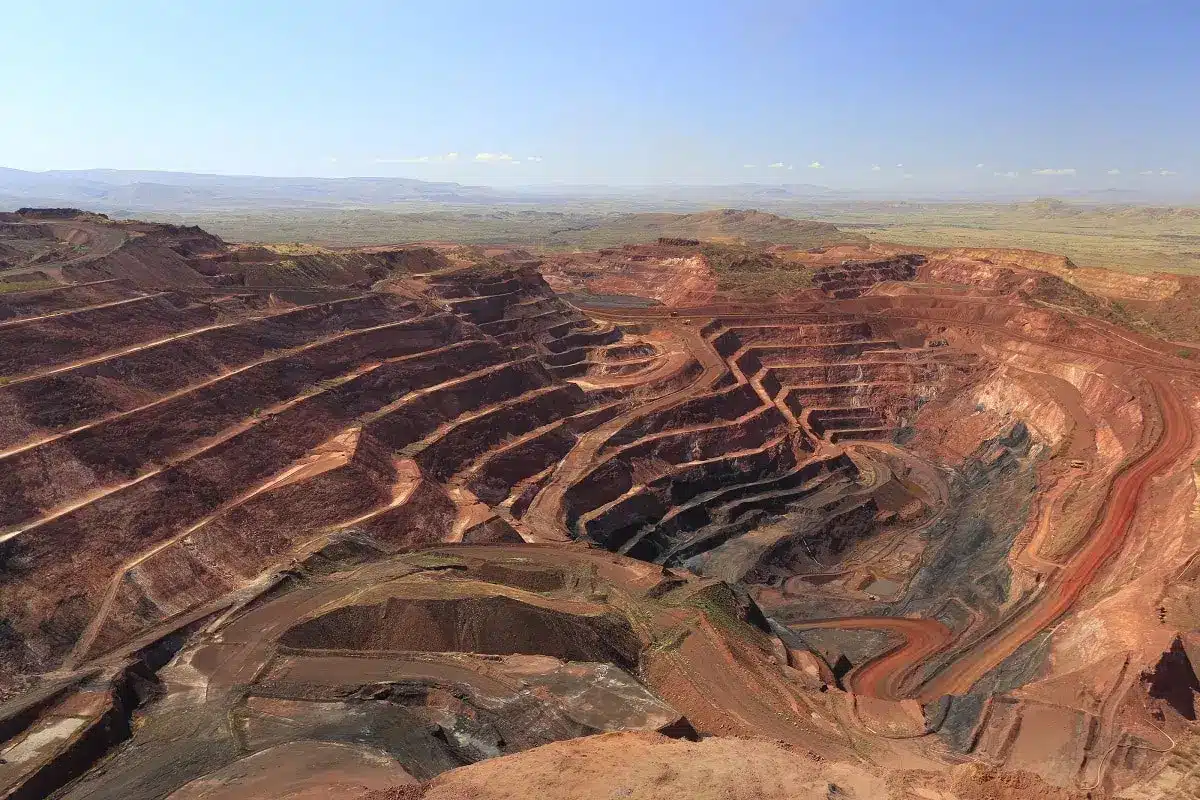

A geological survey in Western Australia has identified what researchers describe as the world's largest iron ore deposit, containing an estimated 55 billion metric tons of high-grade ore in the Hamersley Province of the Pilbara region. Valued at approximately $6 trillion, the find rewrites both mining history and established geological theory — and carries massive implications for global steel markets.
The discovery came through a combination of advanced imaging surveys and isotopic dating methods that placed the deposit's formation at roughly 1.4 billion years ago, far outside the previously accepted window for major iron ore deposits. And the numbers alone make this find almost impossible to overstate.
The Pilbara find that changes everything
Western Australia has long been synonymous with iron ore production, but this deposit in the Hamersley Province operates on a different scale entirely. Geologists identified 55 billion metric tons of high-grade iron ore, with iron content exceeding 60%, a threshold that qualifies material for direct use in steelmaking with minimal processing.
At an estimated valuation of $6 trillion USD, this single deposit dwarfs anything previously catalogued. Industrial observers note that it doesn't just add to Australia's existing reserves — it redefines the country's position as the dominant global supplier of iron-based products. The Pilbara region was already the backbone of Australian iron exports, but this discovery extends that dominance by an order of magnitude.
estimated value of the Hamersley Province iron ore deposit
Advanced imaging and isotopic dating behind the find
The deposit was not stumbled upon. Geologists used advanced survey techniques and cutting-edge imaging technology to map subsurface formations with a precision that older methods couldn't achieve. Alongside these surveys, isotopic analysis and advanced dating methods confirmed the deposit's age at approximately 1.4 billion years.
That figure matters beyond the headline. The scientific consensus had long held that major iron ore deposits formed during a specific geological window, between 2.5 and 1.8 billion years ago, a period associated with dramatic shifts in atmospheric oxygen and ocean chemistry. A deposit of this scale forming roughly 400 million years later than expected forces researchers to revisit foundational assumptions about mineral formation and crustal evolution.
Supercontinents and the geology of iron formation
Researchers are now actively studying the role of supercontinent cycles and tectonic processes in explaining how such a massive deposit formed outside the established timeframe. The movement and breakup of ancient supercontinents may have created the specific geological conditions — pressure, temperature, fluid circulation — that concentrated iron ore at this scale in the Hamersley Province.
This line of inquiry opens a broader question: if the accepted models are incomplete, how many other mineral-rich ancient provinces have been overlooked? Scientists are calling for expanded exploration of similar geological environments, using the same advanced analytical tools and tectonic history studies that made this discovery possible.
Economic and industrial consequences for global steel markets
The implications for the global steel industry are substantial. Steel underpins construction, automotive manufacturing, high-tech fabrication, and infrastructure development worldwide. A single deposit of this size, reliably accessible and high-grade, has the potential to reshape supply chains that currently depend on a fragmented mix of sources with varying reliability.
For countries that import large volumes of steel or iron ore, the discovery offers a potential reduction in dependence on less stable suppliers. If Australian export infrastructure scales to match the deposit's capacity, steel-consuming nations could negotiate supply agreements from a position of greater security. Industrial stakeholders are already reassessing procurement strategies in light of this find.
Iron ore with a grade above 60% iron content is classified as high-grade and commands premium pricing on international markets. It requires significantly less energy to process into steel, making it particularly attractive for manufacturers focused on cost efficiency and carbon reduction.
Price structures, trade agreements, and infrastructure planning
The discovery carries direct consequences for global commodity pricing. A supply increase of this magnitude, once it enters production, exerts downward pressure on iron ore prices — which could stabilize costs for end users in manufacturing and construction, but would also force adjustments in existing trade agreements and long-term supply contracts.
Australian policymakers are already considering upgrades to export infrastructure and logistics networks in the Pilbara region. The scale of the deposit demands port capacity, rail connectivity, and processing facilities that go well beyond current configurations. That investment, in turn, generates regional economic growth: job creation, service sector expansion, and broader transport network development across Western Australia.
Sustainable extraction and environmental responsibility
Mining at this scale doesn't come without friction. The deposit introduces new challenges around extraction efficiency, environmental accountability, and logistical complexity. International stakeholders and Australian authorities alike are expected to push for discussions on ethical sourcing, mining transparency, and frameworks that ensure the economic benefits are distributed through mutually beneficial agreements.
The find is also expected to accelerate innovation in sustainable extraction and ore processing technologies. When a deposit of this value enters the development pipeline, the financial incentive to reduce environmental impact — and avoid regulatory risk — becomes a serious driver of technological investment. New safety protocols and environmental regulations are likely to follow.
A geological discovery with financial reverberations
What makes this find genuinely unusual is the combination of its scale, its grade, and its geological anomaly. Most major discoveries confirm existing models. This one breaks them. The revised formation age of ~1.4 billion years doesn't just shift a number on a timeline — it signals that mineral exploration models may have been systematically underestimating the range of conditions under which large deposits can form.
For investors and mining companies watching the Pilbara region, the immediate question is timeline: how quickly can extraction infrastructure be built, permitted, and brought online? For geologists, the more pressing issue is what this means for unexplored regions with similar ancient tectonic histories. The Hamersley Province find may be the first of several revisions to the global mineral map — and that prospect alone is already driving conversations across the industry about where to look next.
The Hamersley Province deposit — 55 billion metric tons at over 60% iron grade, valued at $6 trillion — is not just the world’s largest known iron ore reserve. It’s a signal that geological and financial models built around iron supply may need fundamental revision.