
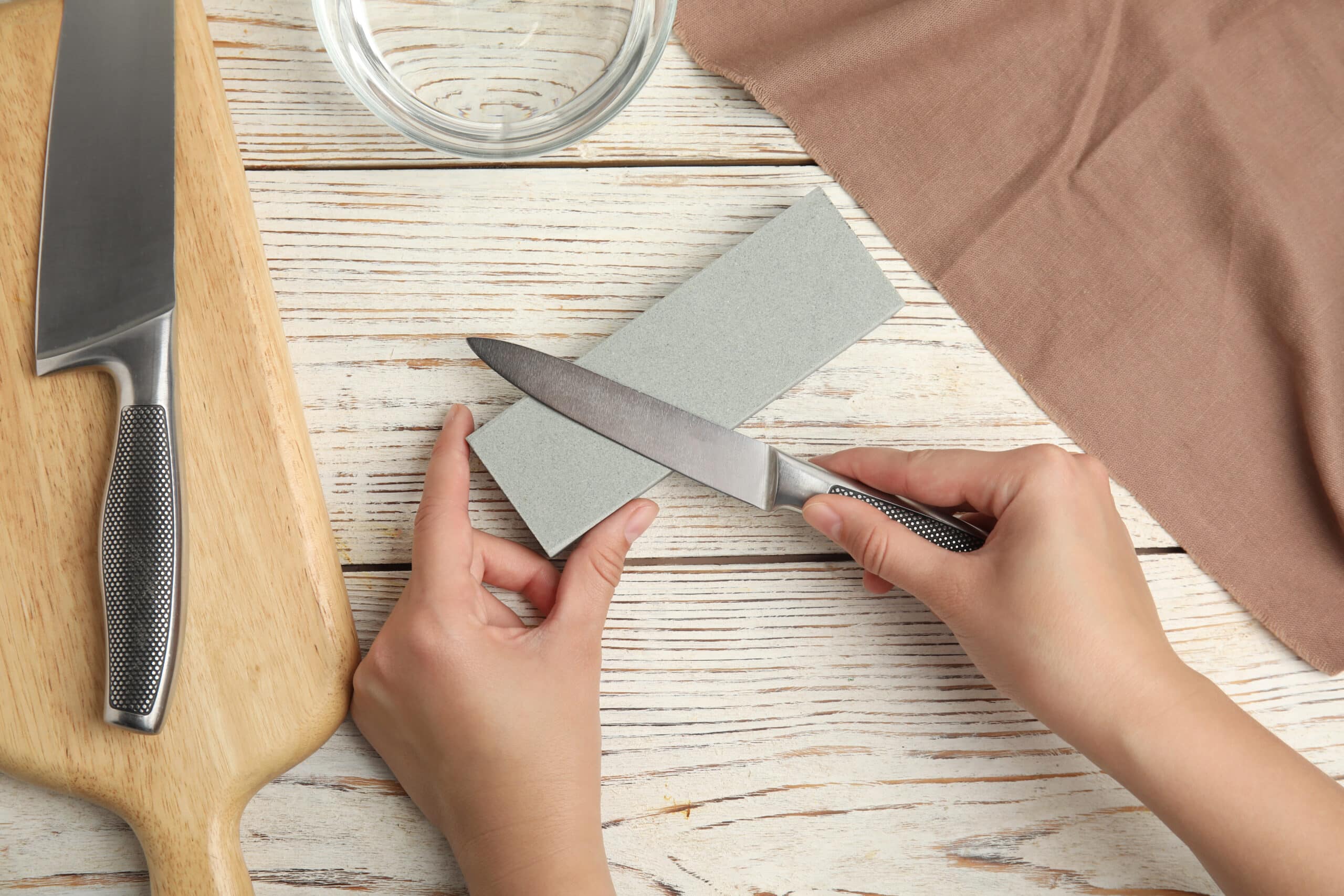

Sharpening a kitchen knife properly is one of the most underrated skills in any cook's repertoire. A sharp blade is safer, more efficient, and longer-lasting than a dull one — but only if you understand the difference between honing and sharpening, and apply each technique correctly.
Most home cooks conflate the two. They reach for whatever tool is closest and wonder why their knives never seem to stay sharp. The reality is more nuanced, and a few consistent habits make all the difference.
Honing vs. sharpening: two different operations
Before touching any blade, it helps to understand what you're actually trying to accomplish. Honing and sharpening are not interchangeable terms — they describe fundamentally different processes with different tools, frequencies, and outcomes.
What honing actually does to your blade
Honing realigns the microscopic edge of a knife without removing significant metal. Over repeated use, the fine edge of a blade folds and bends slightly out of alignment. A honing steel corrects this by straightening the edge back into position. Because no meaningful amount of metal is stripped away, honing is safe to perform daily, or even before every single use. Blade specialists confirm that regular honing minimizes metal fatigue and significantly extends the intervals between full sharpenings.
What sharpening means for knife longevity
Sharpening, by contrast, physically removes metal from the blade to create a new edge. This is why it should be done sparingly — every few months for home cooks who hone consistently. Each sharpening session gradually thins the blade. Over-sharpen with an electric sharpener, and you risk accelerating that wear to the point where the knife becomes structurally compromised. For serious maintenance, expert chefs and blade specialists consistently point to the whetstone as the gold standard: it offers precise control over the angle and pressure applied throughout the process.
Hone your knife daily or before each use. Reserve full sharpening with a whetstone or electric sharpener for every few months — no more.
The right technique for sharpening a kitchen knife
Getting the technique right is where most home cooks fall short. Inconsistent angles, variable pressure, and rushed strokes are the fastest routes to a nicked or unevenly sharpened blade.
Maintaining the correct angle
For Western-style knives, the target angle during sharpening is 20 degrees. Holding that angle consistently across every stroke is the single most important variable in the process. Any deviation introduces micro-imperfections along the edge that compound over time. This is precisely why professionals favor the whetstone — it demands manual discipline, and that discipline produces a superior result.
Working through the grits
When using a whetstone, the process follows a logical progression. Start with a coarse grit surface if the blade is significantly dull or damaged. This removes metal more aggressively and rebuilds the edge geometry. Once the edge is re-established, switch to a fine grit surface to refine and polish the edge for maximum precision. Apply gentle, constant pressure throughout, using a smooth and uniform pulling motion across the full length of the blade. Rushing this step, or varying pressure mid-stroke, is what creates nicks and uneven sections along the cutting edge. After sharpening, always clean the blade to remove metallic residue left behind by the process.
Electric sharpeners follow a similar logic but with less user control. They are acceptable for occasional touch-ups but should not replace whetstone sharpening as a regular practice.
ideal sharpening angle for Western-style kitchen knives
Knife care habits that protect your edge between sharpenings
Sharpening technique matters, but so does everything that happens to the blade outside of sharpening sessions. Several everyday habits directly determine how quickly an edge degrades.
Washing, storing, and cutting surfaces
Dishwashers are among the worst enemies of a knife's edge. The combination of heat, prolonged moisture, and mechanical agitation causes premature dulling and can warp or pit the blade over time. Hand washing is the only appropriate method for maintaining a quality kitchen knife.
Storage matters just as much. Knives left loose in a drawer knock against other utensils and tools, degrading the edge with every contact. Storing blades in dedicated sheaths or compartments protects the cutting edge and prevents accidental dulling between uses.
The cutting surface itself also plays a role. Wood and plastic cutting boards are the appropriate choices for knife maintenance. Harder surfaces — glass, ceramic, stone countertops — accelerate edge wear unnecessarily and should be avoided for any cutting task.
Why a dull knife is more dangerous than a sharp one
This is a point that often surprises people unfamiliar with blade maintenance. A dull knife requires more force to cut through food. More force means less control, and less control significantly increases the risk of the blade slipping and causing accidental cuts. A properly sharpened knife, by contrast, glides through food with minimal effort, produces cleaner cuts, and reduces hand and wrist fatigue during extended prep work. Professionals in commercial kitchens understand this instinctively — the investment in regular maintenance is an investment in both efficiency and safety.
Always hand wash your knives, store them in dedicated sheaths or compartments, and use wood or plastic cutting boards. These three habits alone will noticeably extend the life of any blade.
The discipline required to maintain a kitchen knife properly mirrors the kind of methodical attention that pays off in other technical domains — whether you're learning how to use a new device efficiently or mastering a hands-on skill. Consistency, the right tools, and an understanding of what each step actually accomplishes are what separate a knife that lasts years from one that dulls within weeks. Home cooks who commit to daily honing, periodic whetstone sharpening at a steady 20-degree angle, and basic storage and cleaning discipline will find that their blades perform reliably — and that sharpenings become a rare event rather than a constant chore.