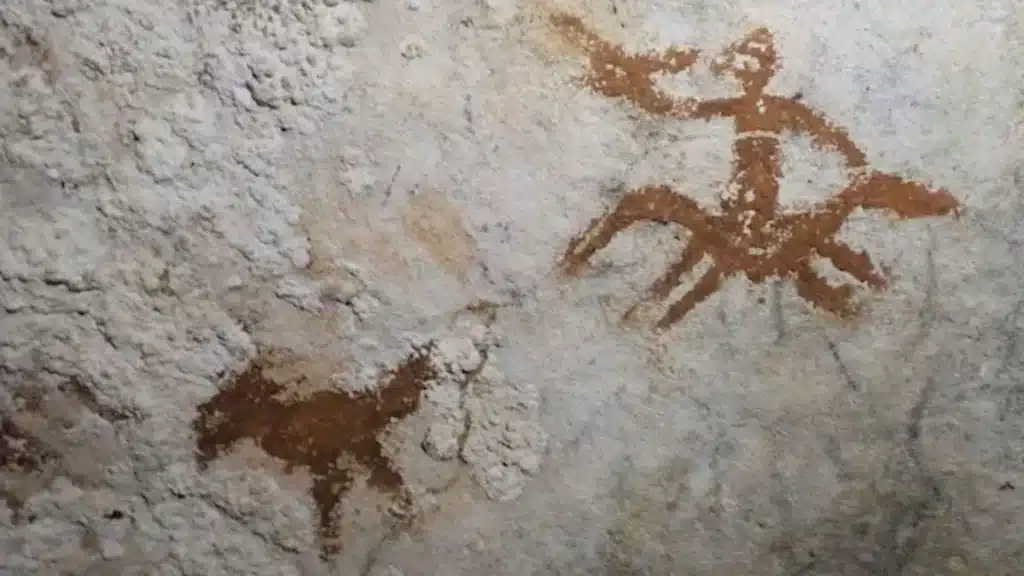

A 67,800-year-old cave painting discovered in the karst caves of Sulawesi, Indonesia, has just been identified as the oldest known example of rock art in human history. Published in Nature on January 21, the study pushes back the timeline of parietal art attributed to Homo sapiens by 15,000 to 16,000 years, reshaping everything archaeologists thought they knew about the origins of human creativity.
The discovery centers on a "negative hand" — a hand stencil created by blowing pigment around a hand pressed against a cave wall. Simple in technique, extraordinary in age. Archaeologist Adhi Agus Oktaviana and Maxime Aubert, a Canadian specialist in uranium-thorium dating, co-discovered and analyzed the painting. Their finding doesn't just set a new record. It forces a fundamental reassessment of when and where symbolic human thought first emerged.
The oldest cave painting and how scientists dated it
The hand stencil was found in a karst cave on the island of Sulawesi, part of the Indonesian archipelago. Dating it required precision. Aubert's laboratory applied uranium-thorium dating to a thin layer of calcite that had formed naturally over the painting — calcite absorbs uranium from groundwater over time, and the ratio between uranium and its decay product thorium reveals a minimum age with high accuracy.
The result: the hand is at least 67,800 years old. That figure is a floor, not a ceiling. The painting itself could be older still, since the calcite formed after the pigment was applied.
A wall used across tens of thousands of years
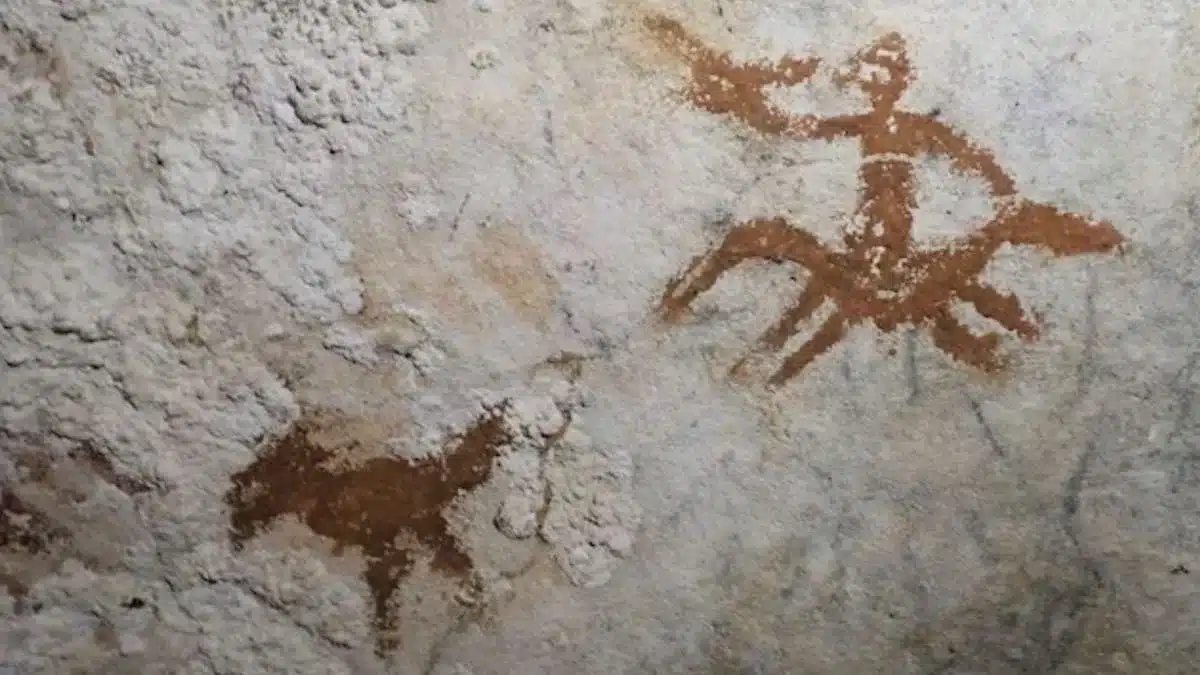
What makes the site even more striking is the layering. Superimposed directly over the ancient hand stencil are two more recent images — a bird silhouette and a rider silhouette — separated from the original painting by more than 60,000 years. The same wall, used and reused across an almost incomprehensible stretch of time. Researchers describe these caves as probable sacred sites frequented for tens of millennia, a conclusion that the stratigraphic record of paintings now supports with hard data.
Sulawesi's place in the history of prehistoric art
This is not the first record-breaking discovery from Sulawesi. In 2019, a hunting scene featuring bovids and therianthropes — figures with human bodies and animal heads — was dated to 44,000 years ago. Then in 2024, researchers presented human figures interacting with a pig, a narrative composition dated to 51,200 years ago, making it the oldest known narrative painting at the time. The new hand stencil, at 67,800 years, now surpasses all of them. Sulawesi is confirmed as the home of one of the richest and most enduring artistic cultures in human prehistory.
The previous record holder and what changes now
Before this discovery, the strongest candidate for the world's oldest known drawing was a ladder-like shape found in the Cave of El Castillo in Spain, dated to approximately 64,000 years ago. That site was associated with Neanderthals, who occupied the region at the time. The Sulawesi hand, attributed to Homo sapiens, is older by nearly 4,000 years — and it is unambiguously figurative, not abstract.
The 67,800-year figure represents a minimum age. Because uranium-thorium dating measures the calcite layer deposited over the painting, the actual artwork could predate this estimate by an unknown margin.
The implications extend well beyond a change in the record books. Pushing back the timeline of Homo sapiens rock art by 15,000 years means that symbolic, representational thinking was present in our species far earlier than previously documented. And the fact that this evidence comes from Southeast Asia, not Europe, challenges the long-standing Eurocentric narrative of where human culture "began."
Migration routes and the broader archaeological context
The Sulawesi discovery doesn't stand alone. It connects directly to a wider body of research on how Homo sapiens migrated from Eurasia toward the continent of Sahul — the ancient landmass that encompassed modern Australia, New Guinea, and Tasmania.
Archaeologists have identified two migration routes toward Sahul. The southern route ran along the coast of Java, while the northern route passed through Borneo, then Sulawesi, then into western Papua. Both paths required open-water crossings: early stretches of 20 to 30 km across sea channels, with a final passage of 90 to 100 km to reach Sahul itself. Roughly 68,000 years ago, sea levels were more than 100 meters lower than today, making some of those crossings shorter — but not trivial.
Converging evidence from genetics and paleontology
A separate study published in late November, drawing on paleogenetics, estimated that Sahul was populated approximately 60,000 years ago. That figure aligns closely with the archaeological evidence from Sulawesi. Fossil evidence from Laos adds another data point: a frontal bone found there is dated to 68,000 years ago, representing the oldest known presence of Homo sapiens at the southeastern tip of Eurasia. Homo sapiens had reached northern Australia more than 65,000 years ago, according to excavations in the Arnhem region. Much like the discovery of massive iron deposits in an unlikely location reshuffled economic assumptions, this convergence of evidence reshuffles the entire map of early human dispersal.
years — minimum age of the oldest known cave painting, found in Sulawesi
The hand stencil in Sulawesi now sits at a critical junction in that story. It places Homo sapiens, already capable of symbolic artistic expression, directly on one of the two known migration corridors toward Australia — and does so at a moment in time that is fully consistent with both the genetic and fossil records.
What the Sulawesi caves reveal about human symbolic thought
Ongoing excavations in the karst caves of Sulawesi are digging into the floors in search of further biological and cultural material that might illuminate who these people were. The paintings themselves already say a great deal. The fact that the same wall was painted, then painted again 60,000 years later, suggests not just repeated use but something closer to inherited cultural meaning — a site recognized across generations as significant.
Researchers describe these caves as probable sacred spaces, a characterization that the layering of images across deep time makes difficult to dismiss. The hand stencil, the bird, the rider: three moments of human intention separated by spans of time that dwarf all of recorded history. And just as scientists attempting to revive extinct species are forcing us to reconsider the boundaries of biology, this painting forces a reconsideration of the boundaries of human culture. The capacity for art, for symbolic communication, for marking a wall with the shape of one's own hand — it was there, in a cave on a tropical island, nearly 68,000 years ago. Earlier than anyone had proven before.